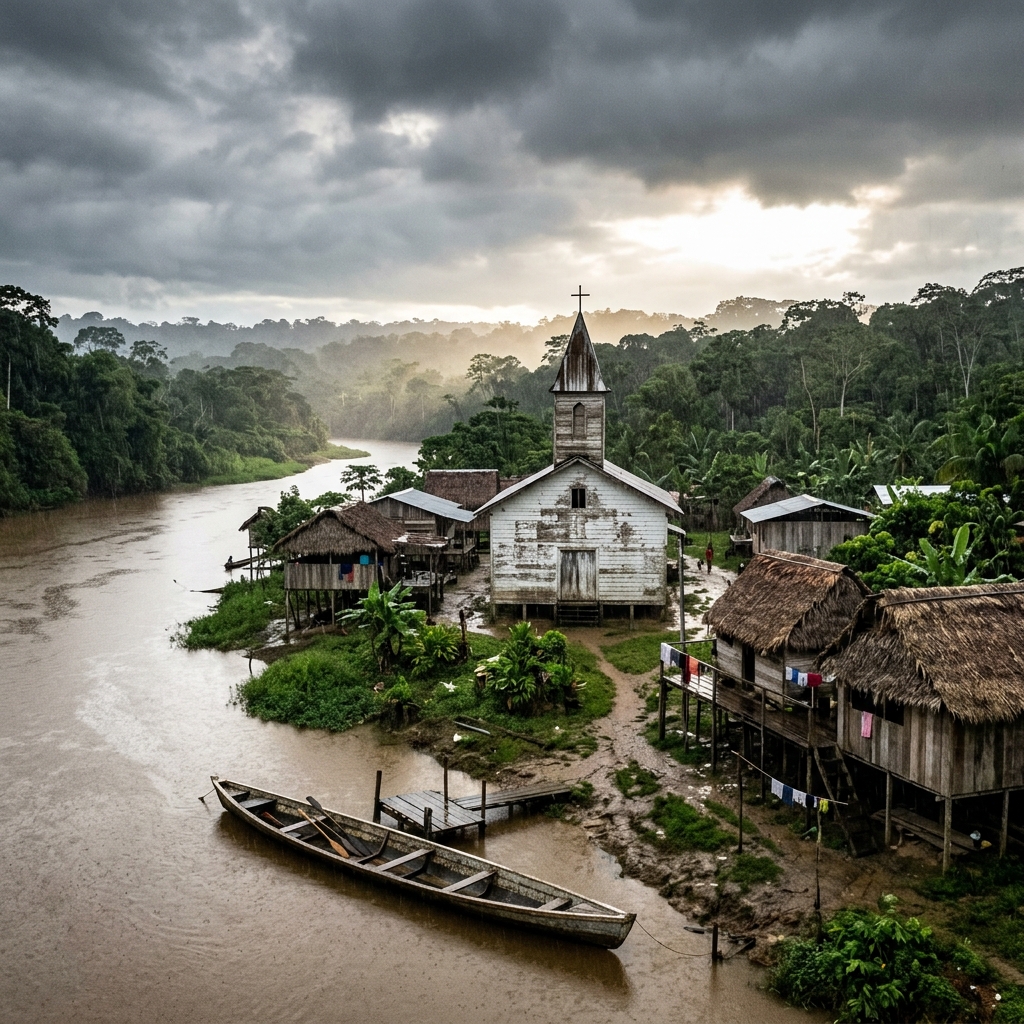
I remember standing at the edge of the concha, the soccer field, watching as many of the men ran around, kicking the soccer ball back and forth. The drizzle started slowly and then turned into a downpour. I quickly ducked under a house raised up on stilts to keep from being soaked by the rain. The walls and floor were made of slotted boards, and through them, I could hear the doctors and nurses from the missions group talking, helping patients, and walking around above me. Their footsteps thumped across the floor, and I could even see glimpses of them through the gaps as they worked hard helping the many indigenous people of the amazon who had come for help. Often traveling many miles by foot or by canoe.
As the rain fell harder, the men playing soccer began to gather under the house as well, trying to escape the downpour. I noticed one man who hadn’t been playing soccer at all. He stood apart from the others, a bit distant. Seizing the moment, I approached him and the group to initiate a conversation. After asking a few questions and talking about soccer, I asked if they would mind if I shared a few verses from the Bible. They agreed, and I opened my Bible, beginning to witness to them.
A while after I started, the rain began to clear, and sunlight broke through the clouds. The men who had been playing football were eager to get back to their game. They quickly dispersed, but the one man stayed. He hadn’t been playing football, and I didn’t know why. As I continued talking, it seemed like he wasn’t interested at all in what I was saying. His eyes darted left, then right. He kept glancing around, restless as if someone was watching him.
I didn’t know at the time, but he belonged to a cult in the village. This group had strict rules. One was that they were not allowed to play any sports, and he wasn’t allowed to listen to other religions or hear anything about Jesus Christ. Yet, culturally, it would have been rude for him to simply walk away, so he stayed. But I could tell he was uncomfortable, eagerly waiting for the conversation to end. Sensing this, I quickly finished, told him that Jesus loved him, gave him the opportunity to pray and asked questions and changed the conversation.
Just as I turned to leave, I heard his name called. The medical team was calling him to see the doctor in the same house we were sheltering under. As he walked away, I noticed three young children quickly slip under the house. They caught my wife’s attention, and she began talking to them. Their appearance stood out—they were dressed very differently from the others in the Amazon village. Despite the scorching heat, the girls wore long white dresses and sunbonnets, while the boy wore long pants and a distinctive shirt. A sash was wrapped around their waists.
I wondered why they were dressed this way, but I didn’t have the answer. My wife approached them and began asking questions—how life was in their village, what kind of food they ate, what their family was like. Slowly, the conversation started to flow, and soon, she opened her Bible and began sharing the gospel with them.
What I didn’t realize at that moment was that these were the children of the man I had just spoken to—the same man who was forbidden by his religion to listen to anything about Jesus Christ. His children were part of that same cult, bound by the same rules. Yet here they were, sitting and listening to the message of the gospel—the very thing they were forbidden to hear.
Several hours earlier as we entered the village in a long wooden canoe, my eyes were drawn to a large white church standing right on the riverbank. It looked old, its peeling paint revealing the wear of time. A tall, narrow steeple reached toward the sky, giving it the appearance of an abandoned frontier church from the Old West. But this church was not abandoned. It was still in use, though the relentless heat and extreme elements of the Amazon were rapidly tearing away at it.
At first glance, it resembled any old Baptist or Methodist church, but I soon realized this was the place of worship for a cult. It was not a house of God proclaiming the love of Christ but rather a place that enforced a rigid and oppressive set of rules—rules that determined whether a person could obtain salvation.
In front of the church stood a massive ten-foot wooden cross, made from a rare and incredibly hard wood, difficult to find in the Amazon. It had been chosen for its durability—resistant to moisture, insects, and decay—ensuring it would stand for generations. The entire cross was painted white, and surrounding it, about ten feet in diameter, was a white picket fence with one small gate to enter, also made from the same unyielding wood.
The people of the cult, including the man I had just spoken to, believed that this cross contained the Holy Spirit. Unlike biblical Christianity, where believers receive the Holy Spirit upon salvation, these followers were taught that the Spirit resided within the wood itself. Every single day, after being “saved,” they had to go to the cross and physically touch it to receive the Holy Spirit for the day. If they forgot, were unable, or simply failed to do so and happened to die, they believed they would perish without the Spirit and be condemned to an eternity in hell.
Not only was this daily ritual necessary for receiving the Spirit, but it was also required for the forgiveness of sins. Each day, they had to touch the cross to be cleansed, believing that if they died without obtaining that day’s forgiveness, they would be lost forever. Some villagers walked great distances every day, fearing that without this act, their salvation would slip away.
Due to poor hygiene and contaminated water, sickness was rampant in the village. Almost everyone suffered from parasites and worms, fevers were common, and various other diseases plagued the people. Yet, rather than seeking medicine or proper treatment, they turned to the cross for healing. Believing that the Holy Spirit resided within its wooden frame, they would pour water over it, then drink the runoff, convinced that this would allow the Spirit to enter them and restore their health.
We know that Christ’s sacrifice on the cross has already redeemed us and that true salvation is found in Him alone. But here, Satan had twisted and distorted the truth, replacing the simplicity of the gospel with a system of bondage—one of rules, rituals, and fear. Instead of offering real salvation, this cult had enslaved its followers in an endless cycle of desperation—never knowing if they were truly saved, never resting in the finished work of Christ.
We know that Christ’s sacrifice on the cross has already redeemed us and that true salvation is found in Him alone.
As my wife kept talking to the young children of this cult, she noticed the young boy was extremely sunburned. Thinking this was why he was at the medical clinic, she asked him how he had gotten burned and why he was so red. His sister quickly answered, saying he got sunburned like that all the time. Yessica asked how and why, and she explained.
In the cult, they were not allowed to play sports at all. Soccer, being a huge sport there, made this very difficult for a young boy who wanted friends and wanted to play. Really, they were not allowed to play any sport that involved a ball, as this was considered a sin. If they were caught playing any sport involving a ball, they had to go see the pastor for punishment. The pastor would sentence them to kneel before the cross during certain hours. Sometimes, it could be for only thirty minutes or even four hours, depending on the severity of the sin.
Since the young boy would sneak out to play soccer every day, he was often caught. Each time, the pastor would make the punishment harder and harder. The day before, he had been caught playing soccer and was ordered to spend hours kneeling at the cross to pay for his sin. Under the scorching Amazon heat and humidity, the boy had kneeled until his legs were numb and asleep while the sun beat down on him and mosquitoes ate at every part of his flesh. His sister explained that while it was painful, her brother would not listen and would still play soccer every chance he got, despite the misery of the torturous punishment inflicted upon him by the church.
The young girl, maybe sixteen years old, continued that, as well, they were not allowed to attend or celebrate anything with a party. When her friends had birthdays, they were restricted from going to the birthday parties. When they had birthdays, they were restricted from having a party or any celebration of it. If the village had a gathering or party, they were not allowed to attend or even gaze upon the celebration. All festivities were strictly forbidden, and the young lady only knew of birthday parties from the stories others had told her.
Wearing different clothes from all the others in the Amazon and this village, my wife asked why they wore these specific clothes. She learned that the young girls of the village were bound by strict rules long before they even reached adulthood. From an early age, they were required to wear a specific dress—a long, modest white gown with long sleeves and a sash tied around the waist—marking them as children who had not yet come of age. This was not simply a tradition but an enforced rule, a sign to the community that they were underage.
Inside the church, for a minor, the restrictions tightened even further. The girls were required to cover their faces during worship, and they could not lift their heads or allow their eyes to meet those of the congregation. Every time they stepped into that building, they were expected to wear nothing but white.
Outside the church as well, their wardrobe was just as strictly regulated. They were only permitted to wear dresses—never pants, never skirts of their choosing. The fabric had to be either white or aquamarine, colors dictated by the cult. Along with the strict rules of clothing, they were required at all times to wear a wooden cross around their neck, made out of the same wood as the giant cross in front of the church, attached with a red rope. If they were caught without the cross around their neck, they were required to kneel in front of the cross for hours in the hot, blistering sun.
As well as the wardrobe restrictions on the girls, they were not allowed to ever cut their hair. It did not matter how long or hot it got; they couldn’t cut their hair. Once the girls came of age, once a month, they were not allowed to attend church. During this time, they were considered unclean and unable to attend. If they were caught going to church during their so-called unclean time of the month, they were punished severely for their disobedience in entering the church as an unclean person.
As the young girls, fourteen and sixteen, and their nine-year-old brother continued explaining the rules and regulations of the cult to Yessica, she told me her heart was torn for them. Here were three young children growing up with zero chance of living a normal life and, apart from this moment, would probably never hear the gospel again. My wife finished explaining the gospel and how Jesus loved them, wanted a relationship with them, and had paid for their sins. At the end of the conversation, they all closed their eyes, bowed their heads, repented of their sins, and accepted Christ as their Savior.
Due to the strong family ties and the need for survival in the Amazon, the children will continue to grow up in this cult. They will continue to be controlled by their parents with zero liberty and strict oversight. They will probably live forever under the rule of the cult leaders, with the threat of expulsion from the community and starvation if they were to leave. But one day, these children will see the heavenly gates and live an eternity in heaven with Jesus Christ.